Routing
Match model capability and cost to the actual task.
Stackbilt field guide · public review
Designing Reliable Generative AI Systems on Cloudflare
Read the free public-review edition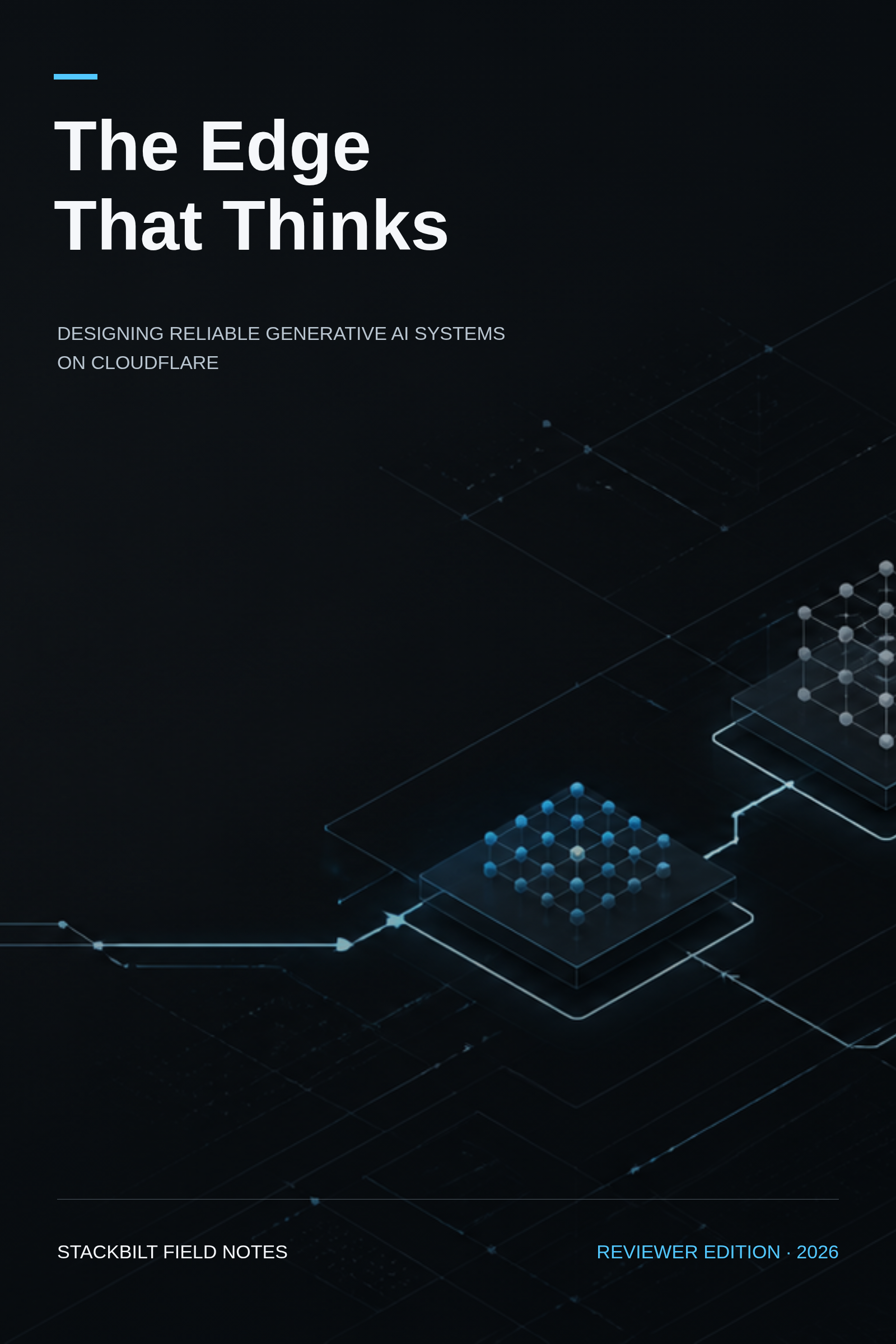
01 / the argument
Most generative AI systems do not fail because the model was not intelligent enough. They fail because the surrounding system could not remember reliably, survive retries, enforce boundaries, control cost, or explain what happened.
The Edge That Thinks is the architecture field guide I wrote from building those surrounding systems across Stackbilt. Its central claim is practical: dependable AI comes from explicit routing and state, durable work, narrow capabilities, preserved provenance, enforceable budgets, and feedback loops that make autonomy earned rather than assumed.
02 / what readers get
Match model capability and cost to the actual task.
Make memory, session, and workflow state explicit.
Separate retrieval, durable knowledge, and transient context.
Design retries, idempotency, and recovery before production.
Treat inference quality, latency, and spend as a portfolio.
Give agents narrow capabilities with enforceable limits.
Preserve enough evidence to explain what happened.
Define who can act, on whose behalf, and for how long.
Expand authority only as a system demonstrates reliability.
Architecture diagrams, case files, and a production checklist.
03 / built from practice
The book draws from systems I have designed and operated, not an idealized reference architecture. Each exposed a different failure boundary in production.
A persistent agent system that joins memory, scheduled work, model routing, governed tools, and operational feedback on the edge.
A production image-generation workload that made quotas, provenance, asynchronous work, and provider boundaries concrete.
Semantic search over exported AI conversations, used to examine retrieval quality, ownership, and durable personal memory.
Shared identity, entitlement, failover, circuit-breaking, and cost controls that keep model access from becoming application policy.
The broader operating surface where contracts, observability, deployment, and governance have to work across products rather than in isolation.
04 / release posture
Version 0.2.1 is a substantive early edition shared for practitioner review. Corrections and review findings will inform version 1.0.
Final accessibility and publication gates remain open. Stackbilt maintains the complete free edition, downloads, version history, corrections, and update ledger; this page documents my authorship, argument, and production experience without creating a second release authority.
05 / continue
Copyright © 2026 Kurt Overmier. All rights reserved.